
Ripple & Chainlink Join Forces to Boost RLUSD Adoption, Meta Unveils Memory Layers To Cut Hallucinations, and more

1.Ripple & Chainlink Join Forces to Boost RLUSD Adoption

In a significant development for the cryptocurrency industry, Coinbase has secured a pivotal victory against the U.S. Securities and Exchange Commission (SEC). The court's decision to halt proceedings allows Coinbase to appeal to the Second Circuit, seeking clarity on whether an investment contract necessitates an actual contract.
This ruling has sparked optimism within the crypto community, as it challenges the SEC's regulatory approach and underscores the industry's demand for clear guidelines. Paul Grewal, Coinbase's Chief Legal Officer, likened the decision to a sports referee pausing the game for a critical review, highlighting its potential impact on future regulatory interpretations.
2.Meta Unveils Memory Layers To Cut Hallucinations

Imagine a world where AI chatbots provide consistently accurate information, free from the frustrating "hallucinations" that often plague them. Meta's recent proposal of scalable memory layers brings us closer to this reality. By enhancing large language models (LLMs) with these layers, AI systems can expand their knowledge base without demanding additional computational resources. This innovation promises not only to boost the factual accuracy of AI responses but also to maintain the swift performance users expect.
The introduction of scalable memory layers marks a significant advancement in AI development. By integrating these memory layers, AI systems can more efficiently store and retrieve factual information, reducing the likelihood of generating incorrect or misleading content. This development is particularly exciting for applications requiring both extensive knowledge and rapid response times, such as virtual assistants and customer service bots. As AI continues to evolve, innovations like these bring us closer to seamless and reliable human-AI interactions.
3.Trump-themed Digital Cards Launch on Bitcoin via Ordinals
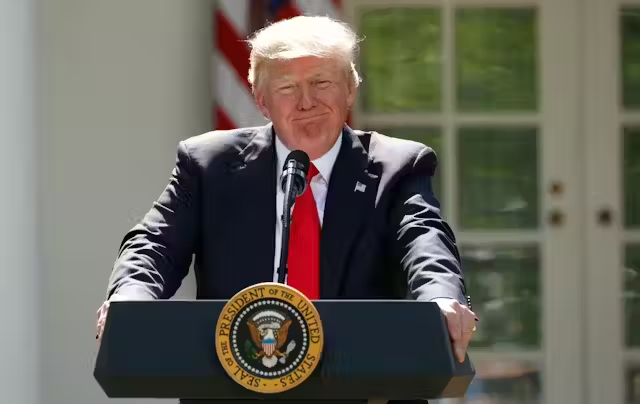
In a bold fusion of politics and technology, President-elect Donald Trump's latest venture into the digital realm has sparked both excitement and skepticism. The launch of "Trump Bitcoin Digital Trading Cards" on the Bitcoin blockchain via the Ordinals protocol marks a significant intersection of political branding and cryptocurrency innovation. Supporters may view this as a pioneering move that leverages blockchain technology to engage with a tech-savvy audience, potentially setting a precedent for political figures embracing digital assets.
However, this initiative also raises concerns about the commercialization of political personas and the implications of intertwining political influence with volatile financial instruments. Critics might argue that such ventures could blur the lines between political engagement and financial speculation, potentially exploiting supporters' enthusiasm for monetary gain. As the world watches this unprecedented melding of politics and cryptocurrency, it prompts a deeper reflection on the ethical boundaries and future implications of such endeavors.